Where Is Your Energy Flowing?
Jun 01, 2025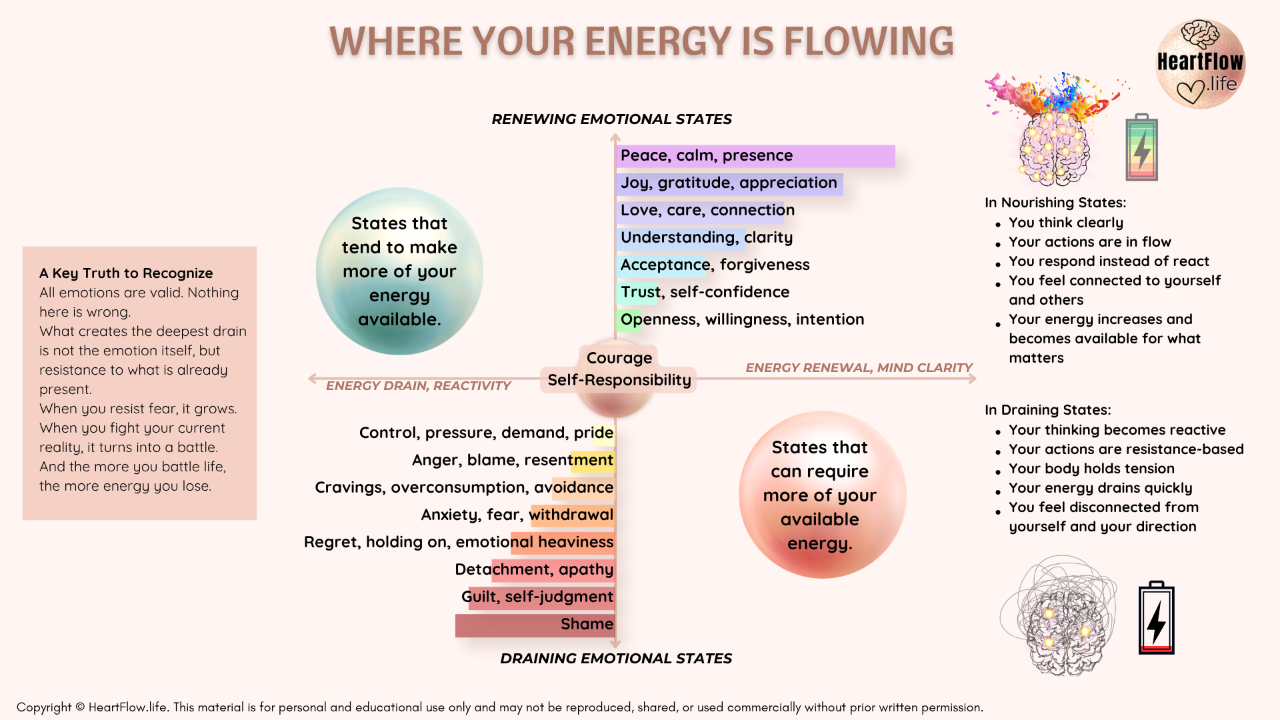
Have you ever noticed that you can spend an hour worrying about something and feel completely exhausted afterward, even though you haven’t physically done anything?
Or you can spend that same hour doing something meaningful, having a beautiful conversation, creating, walking in nature, or solving a problem you care about, and somehow feel like you have more energy than when you started.
We often think about energy in terms of sleep, nutrition, exercise, or how much we are doing. All of those things matter. But there is another place our energy is constantly flowing that we may not notice as easily.
Our inner state.
The emotions we experience, the thoughts we repeat, what we resist, what we try to control, what we hold onto, and where we place our attention all require energy.
And once we begin noticing this, a very different question becomes possible:
Where is my energy actually going?
All Emotions Have a Purpose
Before we talk about draining and renewing states, there is something very important to understand.
There is nothing wrong with feeling fear, anger, sadness, disappointment, frustration, or grief.
These emotions are part of being human. They can bring important information to our awareness. Fear may alert us to uncertainty or danger. Anger may show us that something important has been crossed. Sadness may help us process loss.
The goal is never to force ourselves into gratitude, joy, or peace when that isn’t what we genuinely feel.
In fact, fighting an emotion can sometimes require even more energy than experiencing it.
You feel anxious, and then become frustrated with yourself for being anxious. You feel angry, and then judge yourself for being angry. Something happens that you cannot change, and your mind spends hours replaying how it should have happened differently.
Now you are carrying the original experience and the resistance to it.
This is where a tremendous amount of our energy can disappear without us even realizing it.
The Emotion Isn’t Always What Drains You
An uncomfortable emotion doesn't automatically mean you are in an unhealthy state.
You can feel fear and still move forward with courage.
You can feel sadness while remaining deeply connected to yourself.
You can experience anger and use it to recognize that a boundary needs your attention.
You can be disappointed and still accept the reality of what happened.
The deeper drain often begins when we become caught in resistance, rumination, blame, self-judgment, avoidance, or the need to control something we cannot control.
This is why I find it more helpful to think in terms of draining and renewing inner states, rather than good and bad emotions.
Draining states tend to consume more of our available energy. Renewing states tend to make more of that energy available for clear thinking, connection, creativity, and intentional action.
And we can move between these states many times throughout a single day.
Your Brain Strengthens What You Repeat
Our brains are constantly learning from repetition.
When a particular thought, reaction, or behavior is repeated, the brain becomes more efficient at using that pathway. This is one of the basic principles behind neuroplasticity.
So if your mind has practiced worrying for years, worry may arise very quickly. If you have learned to take responsibility for everyone around you, stepping in may happen before you even consciously decide to do it. If you have learned to carefully monitor other people's reactions, your attention may automatically go toward them before you notice what is happening within yourself.
These responses often developed for a reason. At some point, they may have helped you feel safer, more prepared, more accepted, or more in control.
But a pattern that once protected you can eventually become a source of tremendous energy drain.
The good news is that the same brain that learned the pattern can continue learning.
Where Your Energy Flows Matters
This is what the illustration above is meant to help you notice.
At one end are states such as fear, resentment, guilt, pressure, withdrawal, and self-judgment. These states can require a great deal of energy, particularly when we remain caught in them for long periods of time.
At the other end are states such as calm, appreciation, connection, understanding, trust, openness, and clarity. From these states, we often have more access to perspective and a greater ability to choose how we want to respond.
But I don't think the most important part of this map is the top or the bottom.
It is the middle.
Courage and self-responsibility.
Because moving into a more renewing state doesn't mean pretending you feel differently than you do.
It begins with recognizing:
This is what is happening within me right now.
And then:
What do I want to do with it?
That is where awareness begins creating choice.
You may not be able to choose the emotion that first appears. You may not be able to change another person's behavior, undo what happened yesterday, or know exactly what will happen tomorrow.
But you can begin becoming responsible for where your attention and energy go next.
This Is Where Self-Regulation Becomes So Important
When we are highly activated, our perspective can narrow. We become more reactive, our thoughts can move faster, and it becomes harder to see possibilities outside the story our mind is already telling us.
Simply telling yourself to “stop worrying” or “think positively” usually doesn't create meaningful change.
Sometimes we need another way to interrupt the pattern.
This is one of the reasons I work with structured drawing.
When you bring what is happening inside you onto paper, you are doing something very different from simply thinking about it again. Your attention, movement, visual perception, emotional awareness, and reflection begin working together.
The drawing gives you somewhere to place what you are carrying.
You can notice the tension instead of immediately reacting to it. You can become curious about the story your mind is creating. You can work with what is present rather than fighting it.
And as some of that inner pressure begins to soften, something else often becomes available.
Choice.
From there, the question changes from:
How do I make this feeling go away?
to:
Where do I want my energy to go from here?
Your Patterns Can Show You Where Your Energy Is Going
The interesting part is that we don't all lose energy in the same way.
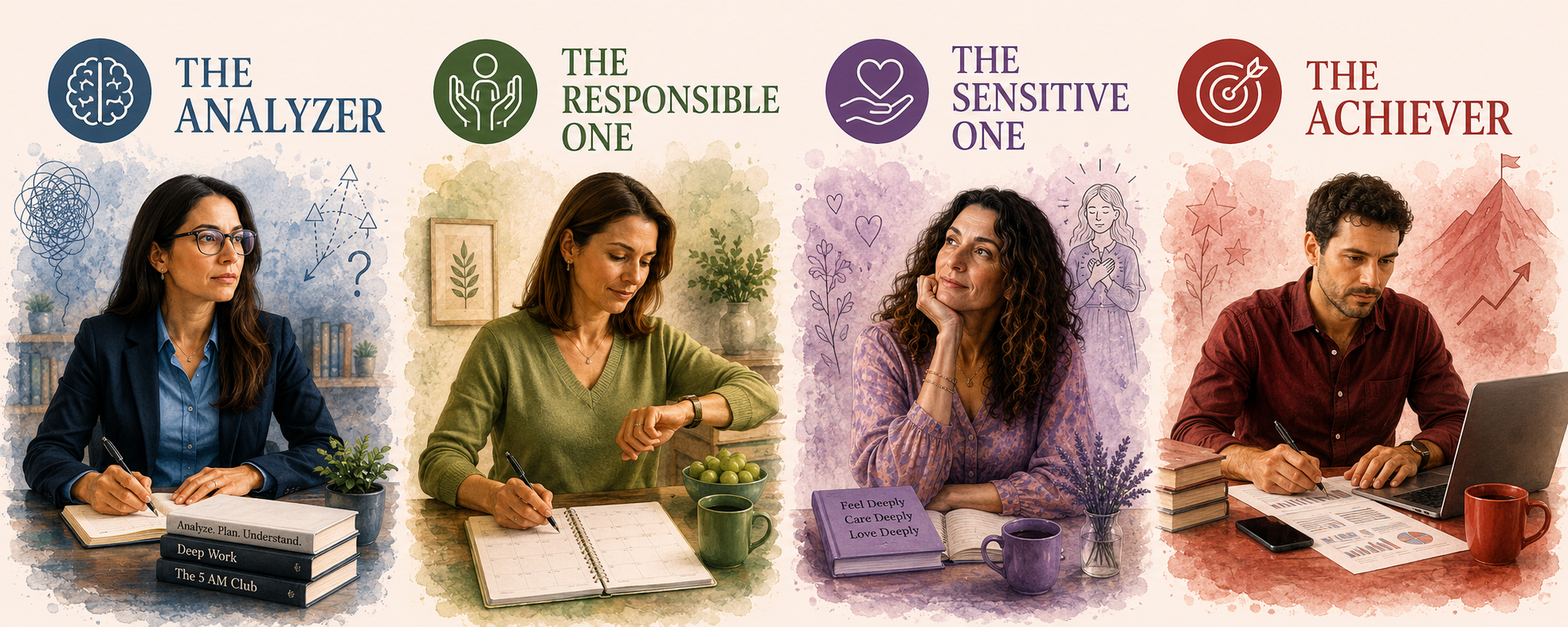
One person may spend enormous amounts of energy thinking, analyzing, researching, and trying to anticipate every possible outcome.
Another may automatically take responsibility for everyone around them, carrying far more than is actually theirs to carry.
Someone else may become so aware of other people's emotions and reactions that they lose connection with their own.
On the surface, these can look completely different.
Underneath, they can all be protective patterns that once helped us navigate life and now may be using energy we need for something else.
And this is why understanding your own pattern can be such a helpful starting point.
You don't need to fight it or make it wrong.
You can begin by seeing it.
Because once you recognize where your energy has been going, you have a much greater opportunity to choose where you want it to flow next.
And sometimes that awareness is the first step toward moving forward with greater clarity, self-trust, and intention.
Discover What’s Keeping You From Moving Forward
Take the HeartFlow Assessment to:
- Discover which protective pattern may be keeping you stuck in your current situation
- Understand how this pattern may be influencing your thoughts, emotions, and choices
- Learn how to work with your pattern rather than against it
- Experience a personalized 5-minute drawing practice to begin moving forward with greater clarity and self-trust
Stay connected!
Join our mailing list to receive the latest posts and updates.
We don't SPAM. We will never sell your information, for any reason.